Pages

Showing posts with label 15th Century Clothing. Show all posts

Monday, September 15, 2014

Manuscript Challenge

I have been pouring over images ever since the Manuscript Challenge glove was dropped.  The rules are simple, but specific and can be found here: http://indemejarecristi.wordpress.com/2014/08/14/i-challenge-you/.

There is also an active Facebook Group found here:

 My mind was filled with extravagant ideas such as Lysbeth van Duvenvoorde (one of my favorite portraits).


Lysbeth van Duvenvoorde

Her outfit has so many wonderful details. As I broke down her outfit into individual elements, I realized that this would be an immense undertaking with only a year to complete.
With the all the other projects on my list (medieval and modern) I decided to be realistic and not set myself up for failure.  I'm keeping her in my back pocket, someday her outfit will be mine!

In search of a more realistic, but equally interesting image, I found myself again looking at one of my favorites.

The Marriage of Philip, the Duke of Burgundy, and Margaret of Flanders from Chroniques de France ou de St Denis contains a wonderful variety of garment styles for both men and women.  I have used it as reference many times when teaching and discussing sleeves styles, in particular.  The women on the right in the blue dress seemed to jump off the page.  I also recently purchased some lovely navy blue wool, so that may have influenced my choice. :-)


I also have been thinking about padded roll headdresses.  They are so prevalent in images of this time, but I rarely seen them recreated in a style that I like.  It has nothing to do with the quality of the reproductions, it's just that they look kind of frumpy and out of place to me (my modern sensibilities shining through). And the thought of wearing one myself has always been… not very exciting. 

With this fair blue lady as my inspiration,  I have resolved to give padded rolls a fair chance! 

Monday, September 8, 2014

Open Hood


Some days, I don't feel like wearing a veil. I just don't.

When looking at images of women from the late 14th and early 15th centuries,  I see many wearing open style hoods.  This style seemed a perfect option to wear during the summer instead of a veil. 
Detail of February (right) and July (left), Tres Riches Heures du Duc de Berry.
I saw Edyth Miller's wonderful interpretation of this style and decided to try one for myself.  Edyth used the tutorial from LiaThornegge for her patterning, but I decided to start with my existing hood pattern.

I used a trial and error process to find the ideal shape. I cut out my classic hood pattern and pinned the pieces together.  I stood  in front of a mirror and adjusted the side gores, edges around the face, and center back seam in order to achieve the look of the hood that is seen in illuminations.  What I ended up with is a hood that has a shorter and less voluminous cape and an opening around the face that is longer so it can be folded back. 

Left: Classic Hood pattern          Right: Open Hood pattern
I designed the hood with a long tail similar to the image below.
Detail of Bible Historiale de Jean de Berry, folio 290r. Bibliothèque nationale de France, Département des Manuscrits, Français 20090
I decided to make this hood a single layer of linen to keep it as light weight as possible since I would be wearing it during the summer and its main purpose is to keep the sun off my face instead of a straw hat or veil.  I finished all the seams in black silk to hide the raw edges on the inside. I used the selvage edge for around the face so there wouldn't be a hemmed edge.
I used running stitches for the seams (outlined in red for visibility).
This hood is very comfortable to wear. I pin it to my St. Brigitta cap and it stays put very nicely and keeps the sun off my face. The edges don't flare as much as in the illuminations, but it it was lined or made of a stiffer fabric it would hold a shape better.


After I finished, I found this image of an open hood with buttons! 

Boccaccio: Decameron c.1414-1419 Manuscript (Pal. lat. 1989), Biblioteca Apostolica, Vatican, Image courtesy of the Web Gallery of Art.


Tuesday, January 21, 2014

How To: Silk Facings

I include silk facings on almost all my garments. They are attractive, comfortable, and easy to make!

I use silk facings around neck openings, on buttonhole facings, and to bind armhole seams. I actually find it easier to create a neckline with a silk facing than without.  The facing helps conceal less than beautiful edges and seam allowances cut too small by you know who… :-)

I use this sample when teaching so the scale is enlarged, but you can see the two rows of running stitch along the top edge and the row of hem stitch on the bottom.
The basic idea of a facing is adding extra material to the edges of a small portion of a garment that serves as a lining.  In the 14th and 15th centuries (and modernly), facings are seen around necklines, wrist openings, and used to strengthen buttonholes. Modernly, facings can be the same fabric as the main garment or a contrasting fabric, but the example I use as inspiration for all my medieval facings is silk.

The image below is an extant piece excavated in London (Baynard's Castle site) and can be seen in the Museum of London's book, Textiles and Clothing: 1150-1450 (Crowfoot, Pritchard, and Staniland, Plate 2) .   This example is a fragment of a wool garment with a silk facing  5 mm wide. That is tiny! The facings I have made are about twice that size on average. 

Silk facing on wool, identified as part of a neck opening. 2nd quarter of the 14th century.
  Medieval Finds from Excavations in London : 4 Textiles and Clothing 1150-1450, Plate 2.
When purchasing fabric for facings, I look for a tabby woven silk that is white or off white. You want it to be light weight (so when you fold the edges over it doesn't add bulk), but not too transparent.  Depending on how many garments you make and the size of the facings, one yard of good silk can last a long time so feel free to spend a bit more on a silk that will be sturdy. I've used the same one yard of silk for many garments over several years and just recently had to buy more. 

Although necks and armholes are curved, cut the silk pieces straight along the grain.  This may seem counter intuitive,  but in the extant example above, the facing is cut on the straight of the grain and then worked around the curve to fit the opening.  All you need is a rectangle of silk that is a little longer than the opening you are facing (don't forget to add seam allowance to your measurements - been there, done that...).  Cutting the silk on the straight of the grain is why a small piece of silk will last for many garments - there is hardly any waste!

Working the silk around a curved edge isn't as difficult as it sounds - I just securely pin the facing in place and work slowly, adjusting as needed while I sew. Ironing the seam allowances over before pinning is a huge help when positioning the silk on the garment.

Each facing will need at least two rows of stitches (three is even better). One row of hem stitch along the bottom (inner) edge and one or two rows of running stitch along the top (outer) edge.

This is a neckline of one of my dresses.  It is red wool, lined in white linen with white silk facings. Forgive the pink tinge! Although I pre-washed the wool, it still bled onto the silk. Whoops!
This is a sleeve from the same dress (yikes! more pink!) showing the position of a facing for buttonholes. Notice how the facing is over the sleeve hem on the left. 
Want to have those cute cloth buttons to go along with your new silk facing? Check out how to make cloth buttons here.

That's all there is to it!  You can even add them to parts of completed garments to spruce them up!  Have fun!

Referenced Works:

Elisabeth Crowfoot, Frances Pritchard, and Kay Staniland, Medieval Finds from Excavations in London : 4 Textiles and Clothing 1150-1450, (Woodbridge: The Boydell Press) 2002.

Sunday, August 25, 2013

How to Make a Fingerloop Lace

I need to make several laces for a project I'm working on - more on that soon - so I thought I would share how I make a basic fingerlooped lace.  I've included a bit of history on fingerloop braids followed by a tutorial to help guide you in making your own.  

Extant fingerloop braids can bee seen in artifacts from excavations from London as well as the on strings of reliquary purses. 

Fingerloop braids of 10 loops (left) and 14 loops (right), 13th and 14th centuries.
Although these examples are more than 5 loops, several examples have been found from the excavations in London made of 5 loops, all dated to the 14th century. 
Museum of London: Textiles and Clothing, pg139

Reliquary purse with multi-colored fingerloop cord, Italy, 15th century.
Royal Institute for Cultural Heritage #10069247
© KIK-IRPA, Brussels
I use a round lace made of 5 loops for the majority of my needs.  I find that this style is easy to learn, easy to execute, versatile, and strong. I make my laces of silk and they withstand a great deal of pressure in my fitted dresses.   The only lace I have broken - so far - was one I accidentally left in a dress and then ran it through the washing machine.  The spin cycle was too much and it broke in half. :-( 

The downside of using finger loops to make a lace is you need to complete the lace in one sitting.  If you put the loops down, they get mixed up easily.  I suppose you could create a rig to keep the loops from getting  tangled,  but I haven't found a good solution (if you have let me know!).   

This style of lace is described in a 15th century braiding manual (Directions for making many sorts of laces - MS Harley 2320) as a 'Lace common round of 5 bows.'  When originally researching this pattern, I found several places online that have the original wording and good translations including: Wire'n String, Silkwerk, and Fingerloop.org

I have included the transcription of the pattern I use from Wire'n String in this post for comparison, but if you are interested in more information about medieval fingerloop patterns, I highly recommend the above sites. 
For to make a round lace of v bowys: Do v bowys on þy fyngres as þu dedyst in þe brode lace. Þen schal A ryght take þorow B and C of þe same hond þe bowe C of þe lyfte hond reuersyd. Þen lowe þy lyfte bowys. Þen schal A lyft take þorow B and C of þe same hond þe bowe C of þe ryȝth hond reuerced. Þen lowe þy ryȝth bowys, & begyn aȝen.
I used trial and error to find my formula to determine the length of my loops.  I double the measurement of my desired finished length and then add the measurement of my finished braid on again for waste and to allow for shrinkage from braiding. It works out to:

Finished length of lace = A
(A x 2) + A = length of thread for one loop

For this lace my calculations are (in inches):
Finished length of lace = 14
14 x 2 = 28 + 14 = 42 inches for one loop

Cut 5 lengths of thread from using the above formula and form 5 loops.  Line them up and tie a knot in one end:


Then tie the loops around a dowel (like a table leg or chair). I use a piece of basic cotton cord to affix the loops to the table:


For this pattern, take one loop each on the 1st, 2nd, and 3rd fingers on your left hand and the 2nd and 3rd fingers on your right hand:


Sometimes untangling the loops is a but difficult, but if you can't get it perfect don't worry. I rarely get them all perfectly arranged, but once you get going the pattern will work out and you can retie the beginning when you are finished if needed to clean it up.

To work the pattern passing the 1st finger of your right hand through the loops on the other fingers of your right hand, grab the bottom half of the bottom loop on your left hand:


You now have 3 loops on your right hand and 2 on your left:


Move the loops on your left hand down so they  are on the 2nd and 3rd fingers. This will be the mirror image of your original starting position.  After each pass, I swing my hands outward to create tension in the braid.  Repeat the above step with your left hand until you reach your desired length. 

Remain watchful for mischievous helpers!


The finished product:


Once you have your lace, you can add metal aiglets to the ends.  These make it easy to feed the lace through eyelets. I purchased these aiglets from Historic Enterprises and they have a small hole so you can sew the aiglets to the lace. Shhh, I have been known to use a drop of Krazy glue to keep the lace from pulling out!

.

This lace was a prototype for my current project. I decided it turned out too thin, so I either will use a thicker thread or try doubling up the loops.  


Sunday, August 18, 2013

Fabric Buttons

One aspect of 14th century clothing that immediately comes to mind is - buttons. Lots of them. Buttons on the fronts of garments, on sleeves, on collars, on hoods... the list goes on and on.  Here is a little back story on fabric buttons and how I make them. Enjoy!

Buttons of various materials were used throughout the medieval period, but the cost rises quickly when they are metal or precious materials, both then and now. Buttons from the 14th and 15th centuries can be seen on effigies, in illuminations, and have been found in multiple archaeological excavations.

Isabel de Malyns, with buttons on the front of her dress and sleeves, 1385. 
Courtesy of the Medieval Combat Society
Man with buttons on the front of his garment, late 14th century. 
Grand Chronique de France, British Library, Royal 20 C VII, f. 22v

Buttons on a sleeve from excavations in London, 2nd quarter of the 14th century. 
Museum of London: Textiles and Clothing, Plate 1

Buttons from excavations in Greenland with concentric rows of stitches.  Some buttons found in London also have the same treatment.  Herjolfsnæs Churchyard, possibly 1380-1530. Else Østergård, Woven into the Earth, p170
The most cost effective way to add miles of buttons to your clothing is making them from fabric.  You can make lots of these little round balls from only a small amount of scrap material.

'Self-stuffed' buttons are the easiest to make and I find they are suitable for the majority of situations.   With a bit of practice, creating fabric buttons is quick and easy. They can be made of any material: linen, wool, or silk.

Here is how I make my fabric buttons.  Good luck and have fun!

Cut a circle of fabric (finding the right size circle to start with can take some trial and error).  Sew a row of running stitches around the circle.  Placing your row of stitches closer to the edge is useful if your fabric is very thick:


Gently pull the thread to draw the circle in and push the edges of the circle into the center "bag" that forms with your finger:


Here is the button with the edges about half tucked in:


Work your way around the circle until all the edges are gathered inside:


Close up the button with several stitches across the bottom:


While closing the button, you may need to work it with your fingers into a round ball. That's it!


Now that you have a button, how do you attach it to your garment? 
Glad you asked!

 Bring your thread up through the edge of your garment:


Pass the thread through near the base of the button and back into the garment to form 'loops.'  Sew as many as you need to make the button secure. You will want to pull the threads tighter than in the image below:


Wrap the thread around the stitches several times. This creates a shank for the button:


Tie off the end and you are done!


Repeat until you have as many buttons as you desire!


(If you are as in love with Pinterest as I am, you may like this photo montage of the process)


Sunday, August 11, 2013

Dressing the Royals

I was honored that Maynard and Liadain, the current royalty of AEthelmearc, asked me to make clothing for their reign. Here is some information about the finished products:

I chose to make Maynard a cote of linen using the same pattern I used to make my husband's cote.   I used blue linen for the outer layer and white linen for the lining.  The main seams are all machine sewn, but the hems and buttonholes are hand finished with silk facings.


For Liadain, I created two garments, an under dress of black linen and an outer dress of blue linen.  The under dress is spiral laced at the center front with gold buttons on the sleeves.  I used the curved front fitting technique described by Tasha Dandelion Kelly to fit the pattern. 


The outer dress is styled after Margaret of Flanders from the Chroniques de France ou de St Denis in the British Library (Royal 20 C VII: f. 182). I like the drape of the long sleeves on this fitted dress; they look regal and have more weight than plain white tippets.


Margaret of Flanders (front in the red dress) Chroniques de France ou de St Denis in the British Library (Royal 20 C VII: f. 182).

Since we live several hours apart, I had limited access for multiple fittings.  I made the initial pattern for the body of the outer dress using one panel for the front and two for the back (to add shape along the spine).  I copied the lines of the side seams from her under dress and then tweaked the pattern at a second and final fitting.


I decided to make this dress lace on the side in order to have a clean front, similar to the image below: 


Side lacing: Tacuinum Sanitatis Lombardy c. 1390s, BNF Ms Nouvelle acq. lat. 1673, f.96r.

I patterned the sleeves using my standard upper sleeve pattern (my pattern for long sleeves is normally constructed with a seam at the elbow like in the Charles de Blois pourpoint - more on that in a future post).  I altered the seam so instead of being along the back of the arm, it is at the front.  This allowed me to create the upper sleeve and the long 'tail' as one piece with an opening at the front.  I lined the sleeve in white.  Similar to Maynard's piece, all the main seams are machine stitched and the hems, button holes, and silk facings are all hand finished.

Although I neglected to take pictures of the pieces separately, I did get a nice photo of them both wearing the finished product:


And one showing more detail on the sleeves of Liadain's outfit:


Looks like two happy customers!

Wednesday, April 10, 2013

Men's Early 15th Century Cote


This is the last post about my entries from the Kingdom of AEthelmearc's Arts and Sciences Pentathlon at Ice Dragon, but fear not! I have more projects in the works that will appear here soon!

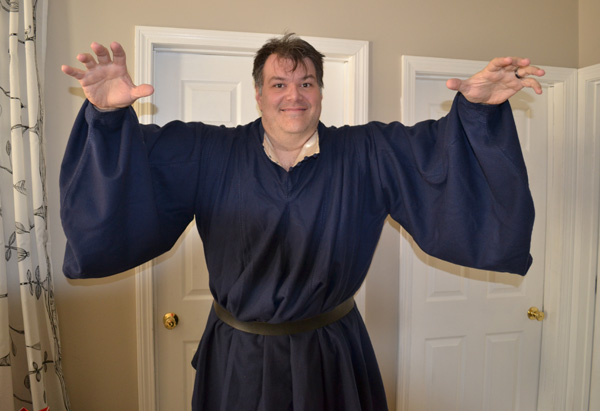
This garment is a man’s houppelande or cote.  This style of garment gained popularity during the late 14th- early 15th century in England and France.  It is essentially a baggy outer layer constructed in a way to create large loose waves of fabric.  It is often seen belted at the waist, which accentuates the pleated appearance around the body.  The sleeves styles of these garments vary from utilitarian and straight to extravagant and flowing. 

Man hunting rabbits.  Gaston Phébus.
My interpretation of a garment similar to the image above.


My goal was to create an outer layer piece of clothing for a spring or fall season that is appropriate for a noble in an everyday setting.  I wanted the sleeves to be stylish, but not cumbersome so I chose a bag sleeve with a fitted wrist.  The primary images I referenced for visual inspiration come from the Hunting Book of Gaston Phébus and the Chroniques de France ou de St Denis. In order to achieve the desired fullness in the body, I created a pattern combining a two existing theories.


Design 

The pattern I created for this garment is a combination of two theories on constructing a houppelande.  I liked the orientation of the shoulder seam Cynthia Virtue used in her pattern.   This gives the garment the desired fullness falling from the shoulders, however, as medieval fabric commonly much narrower than modern cloth I did not want to make quarter circle sections from a single modern width of fabric.  Gores and gussets are a staple of medieval clothing construction and using some variation of panels to create a full houppelande is a logical solution. 

I found an image of an extant houppelande from Czechoslovakia dated to 1396.  I also found a webpage by Master Jack Baynard (as known in the SCA) with a line drawing of the pattern that had the top of the panels oriented to the neckline.  The shoulder seam is formed from the side panel only.  There was no citation for the article Master Jack references so I was unable to verify his conclusions, however, they seem logical.  I decided to use panels similar to Master Jack, but I oriented the panels so they meet at the shoulder seam similar to Cynthia Virtue’s design.  I also curved the shoulder seam to give some extra fullness when the seam settles on the wearer.
My pattern for one quarter of the body.  The pieces are actually right triangles.


The neckline of the garment is a V-neck with a collar.  This style of neck is seen in Hunting Book of Gaston Phébus.  A back view with seam lines can also be seen in Chroniques de France ou de St Denis.  Designing the body  to have the angled panel at the center front and back with the panels meeting at the shoulder seam created the V shape naturally.  I pieced the collar together after the main body of the garment was finished.   The front and back pieces are slightly different to achieve the correct fit, but the result is similar to the image below.


My pattern for the collar.


The sleeve pattern I designed myself.  The sleeves are cut in a ‘bag’ shape with a close fitted wrist.  I wanted a sleeve with a tight, buttoned wrist. I designed the seam to run along the back of the arm around the elbow (similar to the placement of the seam on the Charles de Blois sleeve) in order for the buttons to fall at the outside of the wrist instead to the underside of the wrist.  This allows the wearer to remain comfortable when resting their arm on a table – the buttons will not press against the arm.  To achieve the proper drape for the bag part of the sleeve with this seam placement, the pattern ends up looking like the image below.  There are three pieces, two traditional ‘bag’ shapes and a thin section that sits on the top of the arm.  This extra piece gives the desired fullness seen in the extant images as well as good placement for the buttoned sleeve.

My sleeve pattern.

Materials

I used navy blue wool 2.2 twill for the outer layers and natural tabby woven linen for the lining. 
Tabby woven ivory silk was used for lining the collar and facings at the wrists and armholes.  Silk linings have been discovered as facings on garment fragments with button holes as well as curved sections believed to be a neckline or armhole.

Linen and silk thread were used to construct the garment.  Beeswax coated linen thread was used for all interior seams and silk was used for facings, visible seams, and finishing. The linen thread is a natural beige color.  This would have been a readily available thread in the early 15th century and when coated with beeswax, very strong.  Only seams not visible from the outside of the garment used linen.  A navy blue filament silk thread was used for all stitching visible on the outside of the finished cote.

Construction

The main seams of the garment were all sewn with a running stitch, stab stitch, or hemstitch.  The linen sections were folded over and flat felled to prevent fraying.  The silk pieces were always folded under to secure the raw edges.  The wool seams including hems are all single fold as the qualities of the wool would prevent severe fraying.  I washed the wool before construction in order to achieve a fulled fabric that would not fray easily.  The buttonholes were creating by cutting a slit in the fabric and binding the edge with a buttonhole stitch.  

I used 16 panels total, 8 for the front and 8 for the back, with a center seam at the front and back.  This seam allows for the panels to join at the shoulder seam and form an easy V-neck as previously discussed in the Design section.  I sewed sections of 4 panels together at a time until I had front right, front left, back right, and back left sections of both the lining and outer layers.  The individual panels were sewn with the straight edge joining an angled edge for stability of the fabric.

To construct the body of the garment, I layered the lining and the outer layer and sewed the pieces together at the main center seams using a running stitch in linen thread.  The wool outer layer was then folded open and stitched down with rows of running stitches of silk thread. The interior details of garments are rarely seen in contemporary images, however, the St. John Altarpiece by Rogier Van der Weyden from 1455 (although several decades later than the intended date of this garment) shows the inside of a garment with the outer layer visible at the center back seam. The seams from the pieces of the lining show that sections of the lining were sewn together before being connected to the outer layer. 

Detail of St. John Altarpiece by Rogier Van der Weyden, 1455.


There are silk facings around the armholes at the shoulder and on the buttonhole side of the wrist opening.  The silk was cut on the straight of the grain.  The silk facing on the sleeve was attached after the hem was completed as seen on textile No. 64 in Textiles and Clothing and was attached using running stitches and an overlapping hemstitch.

Sleeve with silk facing and buttons from Textiles and Clothing.

I chose to decorate the cuffs with several rows of silk running stitch to achieve the same effect as seen in the image below.  

Image from Gaston Phébus, showing a man with a decorated wrist.

My interpretation of the stitched decoration at the wrist.


Buttons are made from circles of wool that were sewn with wide running stitches and then gathered into small balls.  The edges of the circle are folded into the center creating a stuffing that bulks up the button.  A thread shank is formed when the buttons are attached to the very edge of the garment.  Buttons are used at the sleeve openings as well as the neck opening. (I will post a detailed tutorial about button making in a future post!)

An imposing figure! :-)


Bibliography


Luisa Cogliati Arano, The Medieval Health Handbook: Tacuinum Sanitatis, (New York: George Braziller) 1976.
Jack Banyard “Praguestyle Houpelande,” accessed December 2012, http://www.chesholme.com/~jack/prague-houp/.
I. Marc Carlson, “Some Clothing of the Middle Ages,” accessed November 2012, http://www.personal.utulsa.edu/~marc-carlson/cloth/blois.html.
Chroniquesde France ou de St Denis, last quarter 14th century, Royal 20 C VII, British Library, London, accessed September 2012, http://www.bl.uk/catalogues/illuminatedmanuscripts/record.asp?MSID=8466&CollID=16&NStart=200307.
Elisabeth Crowfoot, Frances Pritchard, and Kay Staniland, Medieval Finds from Excavations in London : 4 Textiles and Clothing 1150-1450, (Woodbridge: The Boydell Press) 2002.
Anne D. Hedeman, The Royal Image: Illustrations of the GrandeChroniques de France, 1274-1422, (Berkeley: University of California Press) 1991, accessed February 2013, http://ark.cdlib.org/ark:/13030/ft8k4008jd/.
Martina Hrib and Martin Hrib, “Historicke kostymy a strihy,” accessed December 2012, http://www.kostym.cz.
Tasha Dandelion Kelly, “Cut to pieces by a determined tailor: The piecing of the Charles deBlois pourpoint,” La cotte simple, accessed September 2012, http://cottesimple.com/articles/cut-to-pieces/.
Ian Monk, trans., The Hunting Book of Gaston Phébus, (Dallas: Hackberry Press) 2002.
Stella Mary Newton, Fashion in the Age of the Black Prince, (Woodbridge: The Boydell Press) 2002.
Rogier Van der Weyden, St-John Altarpiece, 1455, Oil on oak panel, 77 cm x 48 cm, Staatliche Museen, Berlin.
Cynthia Virtue, “ATheory on Construction of the Houppelande,’ accessed September, 2012, http://www.virtue.to/articles/circle_houp.html.

Link to Complete documentation in PDF:

//